
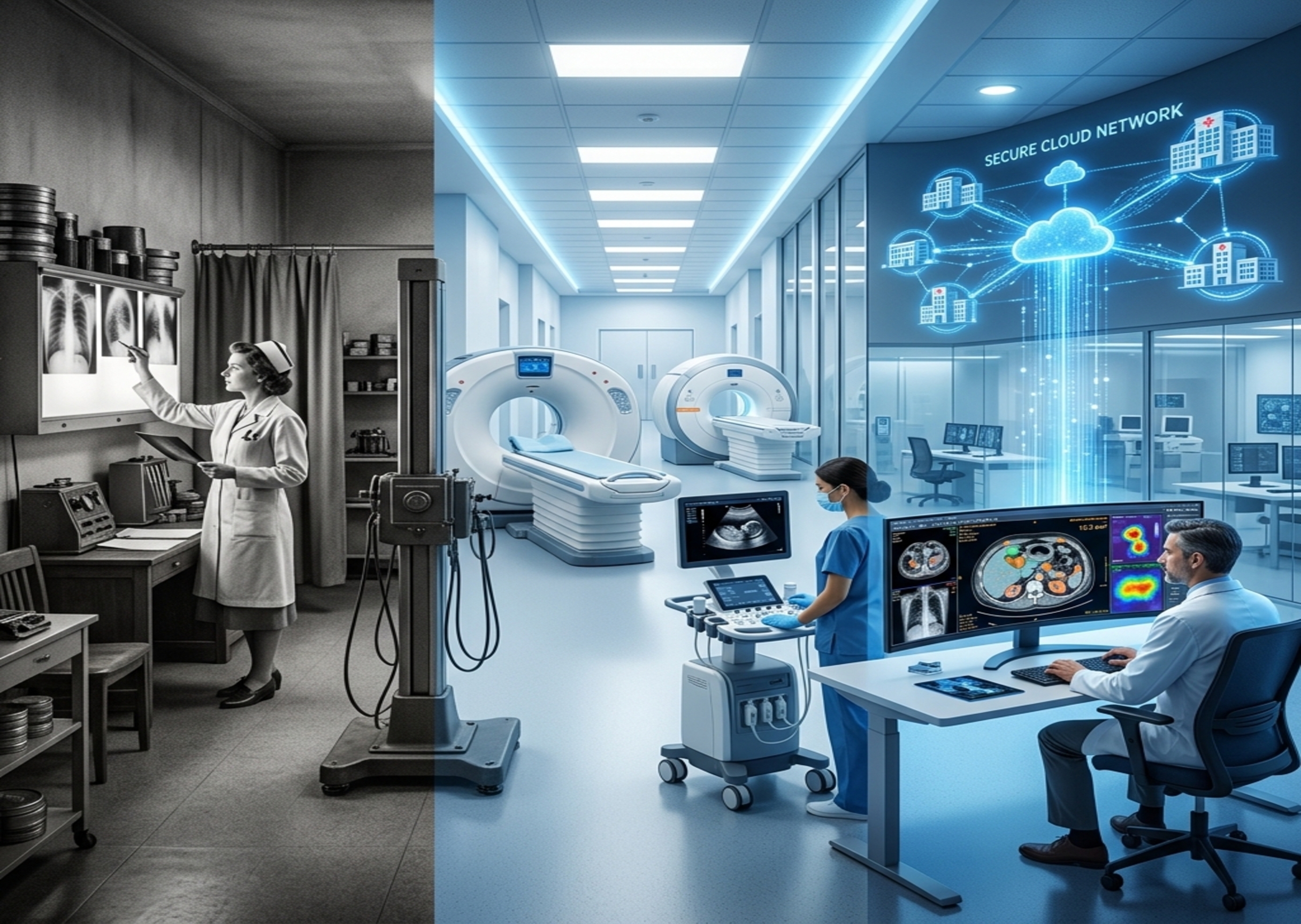
Healthcare has been revolutionized by medical imaging. What started as simple X-ray film systems has developed into an extremely interconnected digital ecosystem that runs on CT, MRI, ultrasound, cloud storage, and AI-assisted diagnostics. DICOM is the heart of that change, and it is the global standard that enables imaging devices and software systems to communicate with each other in a reliable manner.
The modern radiology processes would be more disjointed, slow, and significantly less scalable without DICOM. Hospitals, imaging centers, teleradiology groups, and specialists today rely on DICOM to store, share, review and manage medical images across locations, and devices.
The development of medical imaging was the transition to digital technology whereby X-rays were developed on analog film to more sophisticated digital technology including CT, MRI, ultrasound, mammography, and cloud-based image management systems. The DICOM revolutionized the situation by establishing an international standard of image formatting, storage, transfer and interoperability. It allows healthcare organizations to efficiently interconnect imaging equipment, cloud PACS solutions, viewers, and clinical systems.
Medical imaging has its history as early as 1895 when Wilhelm Conrad Röntgen discovered the X-rays. This innovation enabled doctors to see inside the body and some bones without performing any operation.
Imaging was, for decades, based on film. The radiographs were required to be physically developed and stored in archives and interdepartmental transportation was manual. Although pioneering in its day, film-based imaging presented constraints:
• Slow Turnaround Times
• Physical Storage Requirements
• Difficult Sharing Between Facilities
• Film Loss / Damage Risk.
• Repeat Studies Because Of Unavailable Previous Tests.
With the growth of healthcare systems, these restrictions were more pronounced.
The second half of the twentieth century saw a tremendous acceleration of medical imaging. The new modalities provided clinicians with much greater diagnostic information than they would have received with film X-rays alone.
 - Presented by PostDICOM.jpg)
With every development, volumes of imaging data grew larger. That data proved too technical for healthcare systems using film workflows to handle.
With the computerization of scanners, vendors tended to utilize dedicated file formats and communications. This posed a challenge to interoperability.
A hospital may acquire:
• Ct Scanner Of A Certain Manufacturer.
• Mri System From Another.
• Other Ultrasound Unit.
• Seeing Software Of Another Vendor.
• Another Supplier Solution To Archives.
In the absence of a common language, systems had trouble communicating studies in a consistent manner.
It is due to that challenge that resulted in the development of DICOM.
DICOM is an acronym, which means Digital Imaging and Communications in Medicine.
It is the international standard of storing, transmitting, retrieving, printing and managing medical imaging data. DICOM contains image data, as well as data regarding the metadata, including:
• Patient Identifiers
• Study Date And Time
• Modality Type
• Acquisition Parameters
• Referring Physician Details
• Series Structure
DICOM viewer enables imaging systems of other vendors to communicate with each other using standardized protocols.
 - Presented by PostDICOM.jpg)
DICOM essentially revolutionized the functioning of radiology and enterprise imaging.
DICOM enables scanners, cloud-based PACS, archives, viewers and workstations to communicate studies irrespective of the manufacturer. This helps minimize vendor lock-in and enhances purchase flexibility.
The transmission of images can be made instant as opposed to the physical movement of images on film. That hastens the diagnosis and treatment decision making.
The indexation, storage, backup, and retrieval of digital studies are much more effective than that of physical film libraries.
It allows teleradiology and after-hours coverage since radiologists can consult studies at other facilities.
PACS, VNA and cloud infrastructure can scale as imaging volumes increase, using DICOM-based systems.
| Feature | Film-Based Workflow | DICOM Digital Workflow |
| Storage | Physical shelves | Secure servers / cloud |
| Sharing | Courier / manual transfer | Instant network transfer |
| Retrieval | Manual search | Seconds |
| Backup | Difficult | Automated |
| Remote Reading | No | Yes |
| Collaboration | Limited | Multi-site access |
| Scalability | Poor | High |
This change greatly enhanced efficiency and care to the patient.
With the growth of DICOM usage, it turned out to be the basis of PACS (Picture Archiving and Communication Systems).
DICOM is used by PACS platforms to:
• Receive Studies From Imaging Devices.
• Sort Exams According To Patient And Modality.
• Allow Radiologists To Interpret Studies.
• Distribute Images To Clinicians.
• Maintain Imaging History In The Long Term.
PACS architecture based on DICOM would make modern healthcare imaging departments hard to run effectively.
Non-cloud-based traditional imaging systems were frequently costly to maintain on-premises, locally, and had limited scalability and accessibility. This model was modernised by cloud imaging platforms.
DICOM environments based on the clouds can provide:
• Web-based Image Viewing
• Lower Infrastructure Burden
• Secure External Sharing
• Multi-site Scalability
• Disaster Recovery Resilience
• Easier Collaboration Between Teams
This is particularly useful in expanding imaging centers, outpatient networks and dispersed healthcare organizations.
DICOM standards are quite important in telemedicine. Research done at one site can be safely transported to radiologists at other locations to interpret.
Use cases include:
• Overnight Reading Coverage.
• Access To Specialists In Rural Areas.
• Subspecialty Consultation.
• Multi-site Health Systems.
• Increased Emergency Response Processes.
In the absence of DICOM standardization, it would be much harder to perform reliable remote interpretation at scale.
DICOM is closely connected with radiology; today, it serves numerous clinical fields.
Examples include:
• Cardiology Imaging
• Orthopedic Imaging
• Dental Imaging
• Oncology Workflows
• Pathology Imaging (growing Fields)
• Women’s Imaging
DICOM continues to be the key to cross-department interoperability as enterprise imaging expands.
Medical imaging is an ever-evolving field. Key trends include:
AI applications may help in triage, prioritization, anomaly identification, workflow optimization and reporting assistance.
Medical institutions are becoming more and more interested in scalable imaging systems that can be accessed using a browser.
Greater interconnection with EHRs, analytics tools, and enterprise platforms gain significance.
Patients are becoming more demanding with regard to accessing their imaging records and reports promptly.
Inter-regional sharing is secure and facilitates consultation, research, and distributed care models.
DICOM has not lost its relevance since it offers the frameworks these innovations can be based on.
Certain technologies become obsolete with the advent of new systems. DICOM has been vital since it keeps up with the industry.
Today its worth is:
• Standardization
• Compatibility
• Scalability
• Reliability
• Vendor Neutrality
• Support For Innovation
Such a combination is not common in healthcare IT.
Leaders of healthcare organizations that consider legacy imaging infrastructure should examine:
• Is It Possible To Scale Imaging With Existing Systems?
• Is The Remote Access Effective And Safe?
• Is There Integration Of Multiple Sites?
• Does It Have Disaster Recovery?
• Are Clinicians Able To Access Images With Ease?
• Does It Have A Good Vendor Interoperability?
Otherwise, there can be valuable improvements in modern DICOM-compatible cloud solutions.
The contemporary organizations are likely to require more than image storage. They require safe access, teamwork, web access and expanded infrastructure.
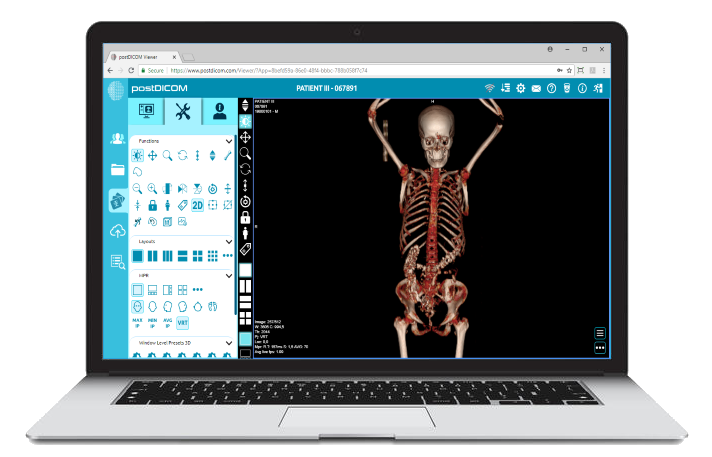
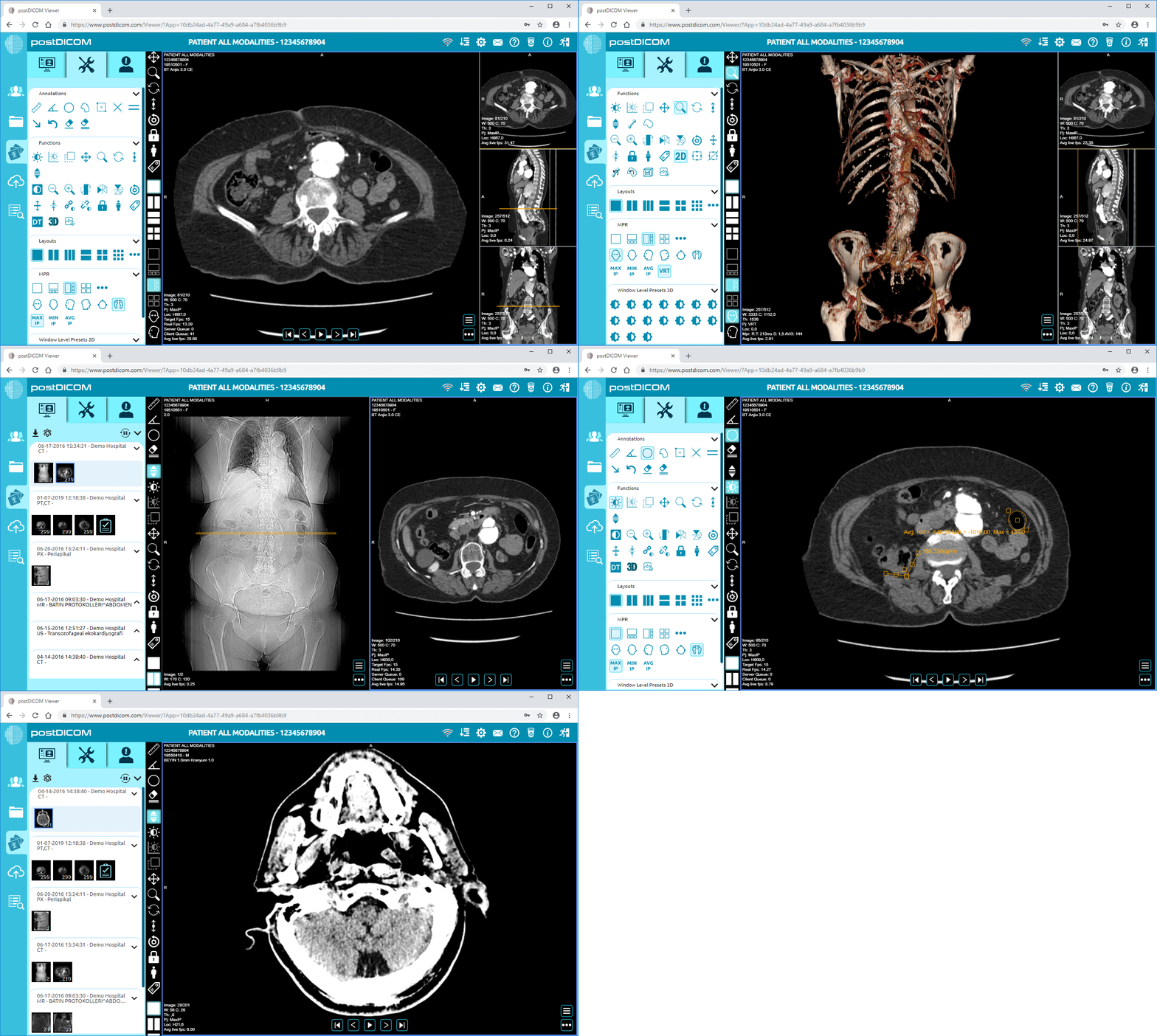
Solutions such as PostDICOM can enable organizations to use DICOM standards in a contemporary cloud environment- to manage, view, and share images without necessarily using the old on-premise models.
• Medical Imaging Developed Into Film Archives To Sophisticated Digital Ecosystems.
• There Was An Increase In The Complexity Of Imaging Data Due To Ct, Mri, Ultrasound, And Other Modalities.
• Dicom Developed A Common Language Of Medical Imaging Systems.
• Pacs, Cloud Imaging, And Teleradiology Are All Based On Dicom Workflows.
• With The Growth Of Ai And Modern Healthcare Interoperability, Dicom Is Still Vital.
DICOM is the abbreviation of Digital Imaging and Communications in Medicine.
It enables imaging systems and software of various vendors to communicate data in a uniform and secure manner.
No. It has extensive applications outside of radiology, such as cardiology, dental imaging, orthopedics, and others.
DICOM allowed the storage, transmission and retrieval of digital images, eliminating the use of physical libraries of film.
Yes. Numerous cloud image networks adopt the DICOM standards to ensure compatibility and continuity of workflows.
AI has the potential to improve imaging procedures, although DICOM is a standard to manage and share imaging data.
The DICOM is the international standard which is applied to store, format and transfer medical imaging data. PACS is the system which relies on DICOM to store, maintain, retrieve, and present the imaging studies in healthcare organizations. To put it simply, DICOM is the standard and PACS is one of the technologies that are developed on the basis of the standard.
Yes. DICOM has continued to be very pertinent, as most cloud imaging systems continue to be based on DICOM standards due to compatibility, interoperability, and secure image exchange. Although the infrastructure has been transformed over the years to include cloud-based servers compared to on-premise servers, the DICOM remains the core in managing and sharing medical images effectively.
The history of medical imaging is one of clearer visibility, more decisions and greater access to care. DICOM was central to that development, uniting devices, systems and professionals under a common standard.
With imaging ever-evolving towards cloud computing, artificial intelligence, and collaboration across the enterprise, DICOM is still among the most valuable technologies in the next-generation healthcare infrastructure.
|
Cloud PACS and Online DICOM ViewerUpload DICOM images and clinical documents to PostDICOM servers. Store, view, collaborate, and share your medical imaging files. |

