
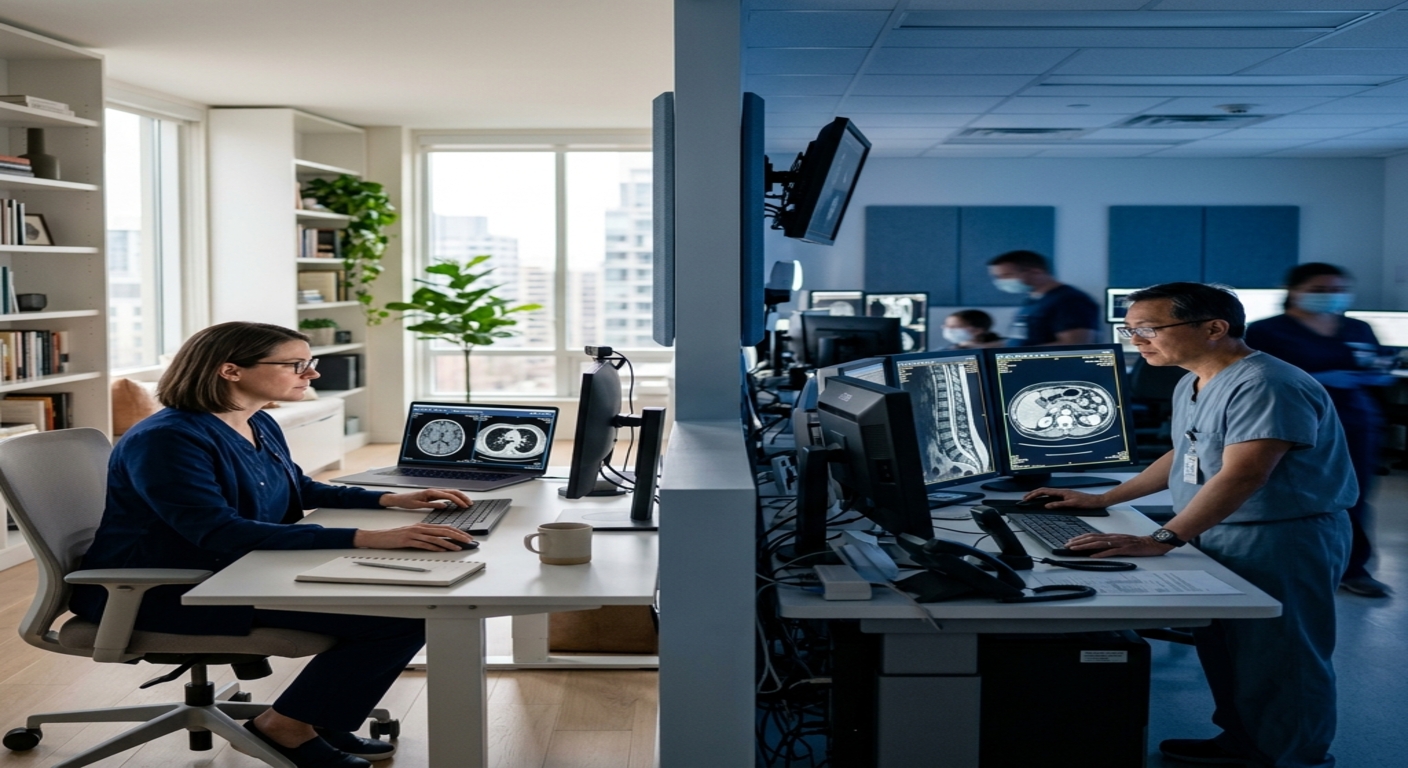
The provision of healthcare is changing swiftly and radiology has been in the center of the change. As the need to diagnose faster, 24/7 reporting and access to specialized expertise increases, healthcare providers are moving towards more flexible imaging solutions. Teleradiology is one of the most significant advances in this field.
Though the conventional radiology has been the standard mode of operation, teleradiology is a new model with the utilisation of digital infrastructure, cloud-based systems and working remotely. Healthcare organizations need to be conscious of the differences between these two approaches to maximize imaging workflows, minimize turnaround times and enhance patient outcomes.
• Teleradiology Facilitates Remote Image Interpretation, Which Makes It Easy To Access And Efficient.
• The Conventional Radiology Depends On Physical Facilities And Human Resources.
• The New Teleradiology Workflow Is Based On Cloud-based Systems And Pacs.
• Flexibility And Scalability Of Healthcare Have Led To An Adoption Of Hybrid Models By Healthcare Providers.
Teleradiology allows the transfer of medical images in a digital format to allow them to be remotely interpreted by radiologists and in the traditional radiology, images must be inspected in a healthcare facility. Teleradiology enables faster reporting, 24/7 access and contact with foreign experts and traditional radiology is dependent upon in-house facilities and physical location, which can limit the opportunity to be flexible, scaled and responsive to an emergency.
The process of sending radiological images to another place to be interpreted by a qualified radiologist is known as telereadiology. It is based on digital imaging standards like DICOM and is normally backed by cloud-based infrastructure.
In teleradiology, the modalities (CT, MRI, X-ray or ultrasound) are sent to remote radiologists, who view the images with the help of sophisticated viewing software. Reports are then created and sent back to the healthcare facility which created.
This model will allow healthcare professionals to tap into radiology skills across geographical borders. It is especially useful in facilities where after-hours coverage or access to subspecialists is needed, or where it is not possible to maintain a large in-house staff.
Traditional radiology can be described as the traditional model where imaging studies are carried out and result interpreted in the same healthcare facility. Radiologists are present at site physically where they view images in local systems like on-premise PACS.
Such a solution can provide opportunities to work directly with clinicians and radiologists, which may be helpful when a more complicated situation has to be diagnosed. It is usually constrained by the availability of staff, working hours, and availability of subspecialists, however.
It is operationally difficult to have full-time radiology coverage in most healthcare settings, particularly in smaller clinics or hospitals in rural areas.
| Feature | Teleradiology | Traditional Radiology |
| Location | Remote | On-site |
| Reporting Speed | Faster (24/7 availability) | Limited by working hours |
| Access to Specialists | Global access | Limited to local expertise |
| Infrastructure | Cloud-based systems | On-premise systems |
| Cost Efficiency | Scalable, lower overhead | Higher operational cost |
| Emergency Support | Immediate remote access | Depends on in-house staff |
Outside these structural differences, the most significant difference is in the operational flexibility. Teleradiology enables healthcare providers to separate the interpretation of imaging with physical location, which results in faster turnaround and more efficient resource use.
In a practical sense, teleradiology and traditional radiology can be explained by the need to choose one over the other, which frequently may depend on operational requirements. Big hospitals with large volumes of patients can be served with teleradiology to resolve overflows and keep a quick turnaround during peak periods. Smaller clinics, in turn, might consider teleradiology one of the main solutions because of the lack of in-house staff.
Teleradiology will be an invaluable resource in emergency situations, as it allows radiologists to be contacted instantly, without time and place constraints. This can greatly help in eliminating delays in diagnosis of a trauma or stroke case. However, traditional radiology is not yet ready to be supplanted in the settings that require that clinicians and radiologists work directly and in real-time to discuss complex cases.
Traditional radiology is good but can be limited by its internal capacity. With the growing imaging demand, there is a chance that there will be a bottleneck with this model, particularly during peak times or staffing crises.
The standard teleradiology workflow starts with the acquisition of images by diagnostic modalities (CT, MRI, or X-ray). These are encoded as per the DICOM standard and sent safely to a cloud-based system such as PACS.
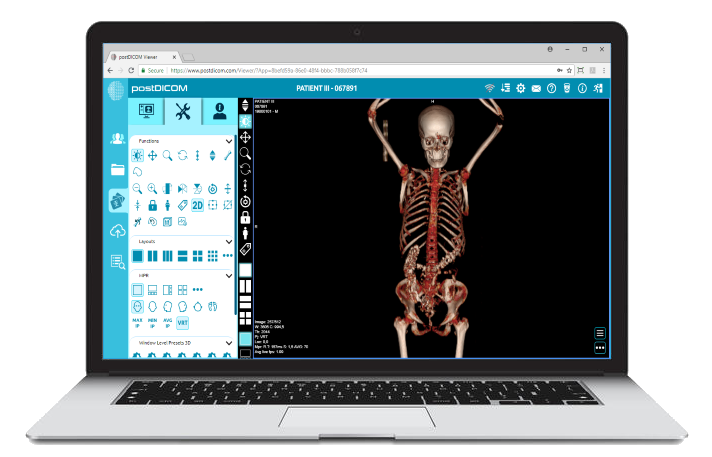
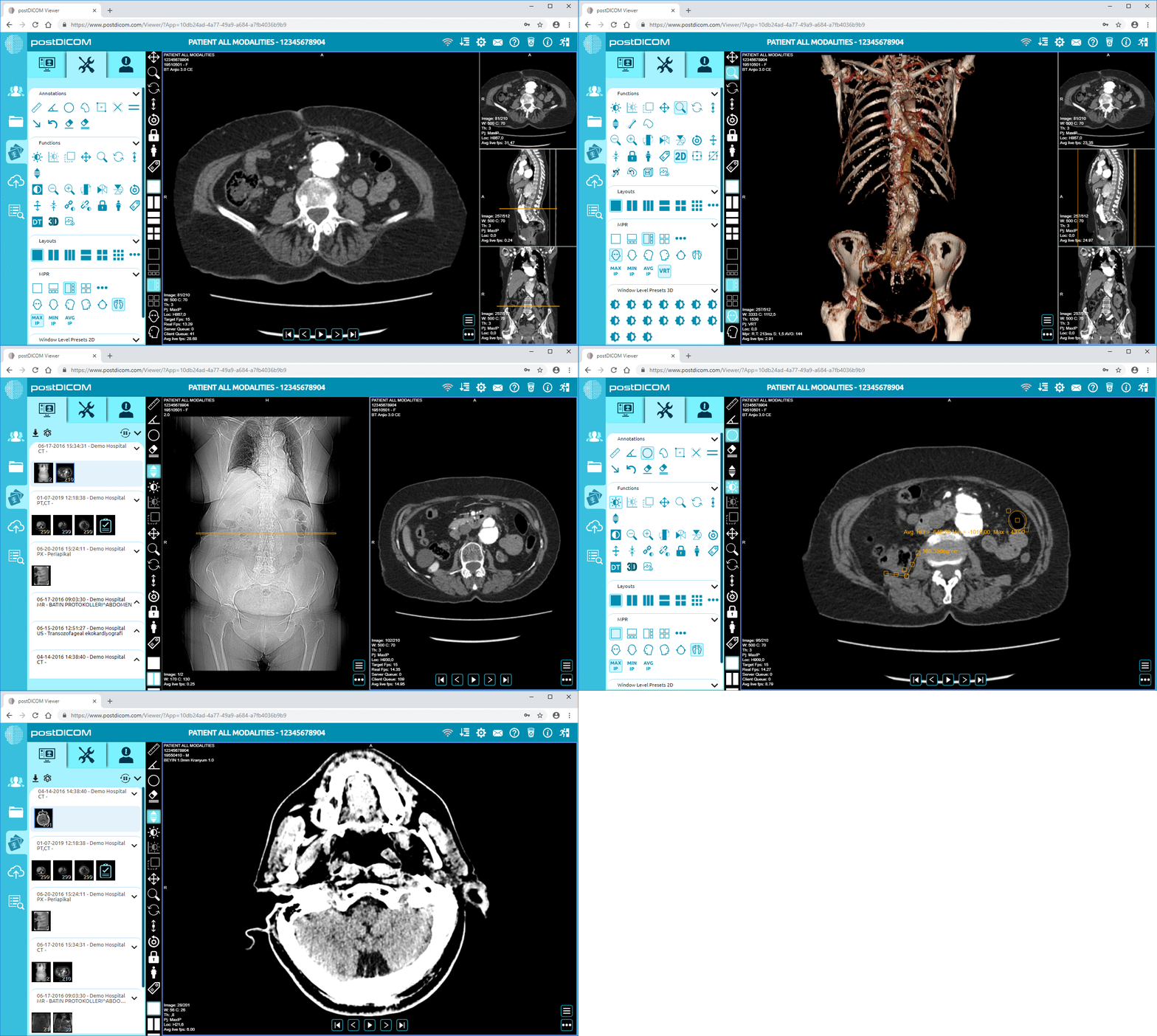
The images are then accessed by radiologists via a web-based DICOM viewer, where they can view the cases anywhere. Diagnostic reports are created after analysis and are sent back to the facility of origin.
Operational-wise, this workflow allows unrestricted imaging services without having to be physically present by radiologists. It is also able to enable healthcare organizations spread the workloads among various radiologists, thus decreasing burnout and enhancing reporting efficiency.
 - Presented by PostDICOM.jpg)
This workflow helps healthcare organizations to:
• Minimize Turnaround Time In Reporting.
• Make Certain Of A 24-hour Radiology Coverage.
• Enhance Cooperation Among Various Sites.
• Maximize Use Of Resources At Departmental Level.
Cloud PACS and web-based viewer integration is a vital component of this process, which is necessary to make it seamless, secure, and scalable.
Teleradiology has a number of benefits that are making it a popular trend among health care providers.
Round the clock availability is one of the most valuable advantages. Radiology services can be availed to healthcare facilities 24/7, even during nights and weekends, without necessarily having to use in-house personnel. This can be of great benefit to the emergency department and urgencies.
Access to subspecialists is another important benefit. Experts may review complex cases in the area of neuroradiology, cardiothoracic imaging, or musculoskeletal radiology. This enhances the accuracy of diagnosis and improves clinical decision-making.
Also, teleradiology ensures cost optimization. Facilities do not need to invest in on-site facilities or a large full-time staff, but can expand their radiology services when needed. This is particularly useful to expanding healthcare networks.
Although traditional radiology is dependable, it has a number of operation limitations that may influence efficiency.
Limited availability is one of the major challenges. Radiology is usually limited to normal working hours, and thus may cause delay in diagnosis at night, weekends or peak times.
The other constraint is limited access to expertise. Smaller or rural healthcare centers may not have access to subspecialists and this may affect the quality and completeness of diagnostic interpretation.
Additionally, the presence of infrastructure and personnel on-site may also add to the cost of operations, particularly when the imaging volumes are diverse. This renders the scaling of some organizations not so easy.
Teleradiology can particularly be practical in situations where healthcare professionals require real-time imaging, or where radiologists are scarce.
High patient volume hospitals tend to employ teleradiology to control overflow cases and minimize delays in reporting. It is used in rural and remote healthcare facilities to tap into expertise that would not have been available locally.
Telemedicine also helps diagnostic centers and telemedicine platforms enhance turnaround times and reach a greater range of services.
Conversely, conventional radiology could still be desirable in a facility with robust in-house staff, predictable workload, and requirement of real-time, physical partnership and collaboration between clinicians and radiologists.
To illustrate, a rural hospital, which does not have a full time radiologist, can employ teleradiology to cover a 24 hours diagnostic coverage. Likewise, in urban hospitals with a high imaging workload, the cases can be handed over to remote radiologists to avoid reporting backlogs.
Centralized teleradiology systems are also beneficial to multi-location healthcare networks thus the teleradiology data in various facilities is centralized and interpreted effectively. This does not only enhance turn around time but also makes all locations have consistent diagnostic standards.
Although teleradiology has benefits, it has a number of challenges that medical practitioners should tackle.
Data security and regulatory compliance is one of the key issues. It is the responsibility of the healthcare organizations to make sure that the patient information is sent and stored safely within the framework of requirements like HIPAA and PHIPA.
The other obstacle is reliance on good internet infrastructure. Any interruption in connectivity may slow down image transmission and reporting, which may affect patient care in urgent scenarios.
Also, licensing and credentialing can be a complex issue when radiologists are working in various areas or countries. Before adopting cross-border teleradiology services, healthcare providers need to make sure that they do not violate the local regulations.
The other factor that should be taken into account is the vendor dependency and system integration. Healthcare providers should make sure that their teleradiology solutions will work with the existing systems, such as PACS, RIS, and EHR platforms. The lack of integration may cause workflow inefficiencies and data silos.
Data governance is becoming an issue of concern as well, especially to organizations that are operating in different regions. Defining the procedures of accessing and storing data and accountability is critical to maintain compliance and integrity of patient data.
The prospects of radiology is gradually shifting towards a hybrid approach where the advantages of tele radiology and conventional radiology are merged.
Healthcare organizations are moving towards flexible workflow where radiologists are able to work on-site and also remotely. This will enhance efficiency and still provide the possibility of having direct clinical collaboration when necessary.
With the technologies of AI-based diagnostics, cloud images platforms, and cutting-edge visualization tools constantly developing, teleradiology will be even more assimilated into the daily clinical routine.
Yes, when properly implemented with adequate systems and certified radiologists, teleradiology can be as diagnostic as traditional radiology.
Teleradiology may be very secure in case of adherence to such standards as HIPAA and PHIPA, and encrypted transmission system.
Yes, teleradiology is particularly useful to small clinics and rural healthcare providers who may not have in-house radiology knowledge.
No, it supplements traditional radiology and is frequently applied in combination with it in hybrid models.
DICOM standards, cloud-based PACS, secure networks, and web-based DICOM viewers are also the key technologies.
|
Cloud PACS and Online DICOM ViewerUpload DICOM images and clinical documents to PostDICOM servers. Store, view, collaborate, and share your medical imaging files. |

